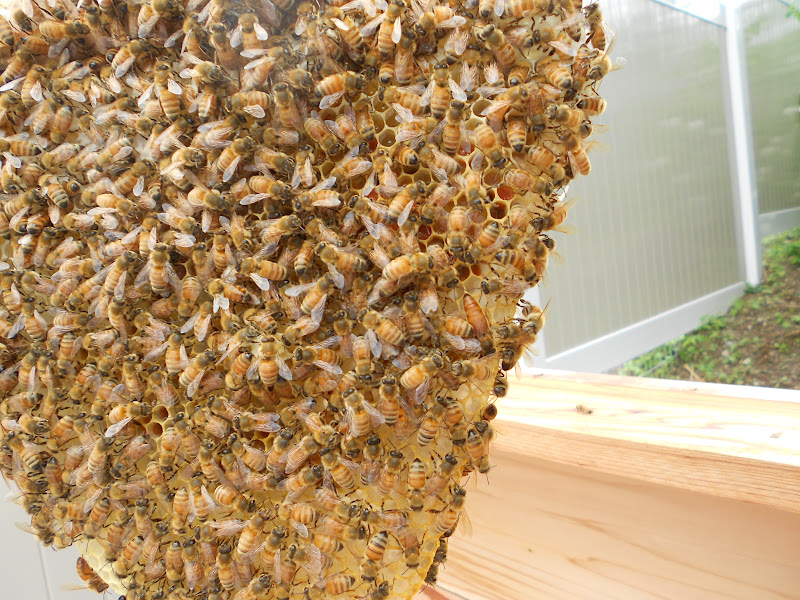
It's been a full month since the installation of our bee packages and those little beauties have been...well...busy as a bee. The Lower hive jumped into production straight out of the gate where the Upper hive was slow going. Within two weeks the Lower hive had five bars built out and every stage of brood, from egg to capped. On inspection of the Upper hive I could not find any sign of egg or brood but was able to locate the queen so three days later I went in for another inspection. What I found were two supersedure cells. These are enlarged cells built on the face of the comb to rear a new queen. This is determined by the worker bees when they deem the reigning queen is insufficient in some way. What this tells me is that the existing queen was laying because you need an egg to make a bee. So I believe that she must have been laying sporadically and not near enough to make the workers feel as though the hive was growing properly.

The supersedure cell in located just left of center on the upper part of the comb. There was another on the other side of this comb as well. As the beekeeper I had to make a decision on what action, if any, I should take. Because my queen was guaranteed to be of high quality I could go back to the vendor and get a new queen. This would involve locating the original queen, disposing of her and the two supersedure cells and their contents then introducing the new replacement queen to the hive. Or I could trust the bees and let nature take it's course. This early in the season the hive would have plenty of time to catch up IF all went well. For all to go well one virgin queen would emerge and kill the other two queens, the one in the other supersedure cell and the original queen. She would then, on a warm rainless day, take a mating flight and hopefully mate with multiple drones from another hive. All of this would take up to 30 days. It wasn't long before the decision was made for me. When I made the call to take delivery of a replacement queen I found that they were fresh out and wouldn't get a delivery for 15 days! So, I left for a week vacation and let the bees take care of themselves! I would like to say that I didn't worry, I did, and had a few nightmares about it too. I had some peace knowing that my son would be checking in on them and updating me.

When I returned from vacation the supercedure cells were gone so I set about finding the new queen. I was unable to so I waited a few weeks and made another inspection and sure enough I spotted her. Can you? She's the large dark orange bee on the right hand side of the comb about half way down. Whew! Now to make sure she has mated. There was a problem. I could not find any eggs so I decided to wait and make another inspection in another week. Thankfully we had some nice weather, perfect for mating. Also on this comb you can see the pollen stores. Those dark colored cells where the workers are making bee bread.
Let's take a look at the Lower hive's progress.
This is a brood comb. Most the cells have hatched and will be cleaned for the queen to lay another egg inside. On the bottom you can see capped brood that are getting ready to emerge. The flatter ones will be female workers the domed ones will be drones. If you look closely you will spot a larvae which will be enclosed soon to go through it's metamorphosis. It is located just right of the queens bottom in the patch of capped brood nearest the center of the comb. The queen in this hive is it's original and is marked with a small yellow dot on her thorax. Another way to identify her is that she is a solid color not striped.

This comb is basically a drone nursery. All those fat little drones lined up are waiting for the female workers to feed them and clean their cells. The workers have helped them emerge by tearing open their cells, then cleaning them and feeding them their first meal. Females are not so lucky. The female bee fights her own way out of her cell and then is expected to clean it get some food for herself and then start caring for larvae. Although not everything is known about the role of the drone in the hive, the two things we do know is that they eat and mate. The queen decides how many workers and how many drones to lay for a balanced hive. These drones will mate with a queen from another hive for diverse genetics.
This hive was going strong but due to the fast growth started to run low on honey and pollen stores so I've decided to keep feeding them sugar syrup until the blackberry nectar flow starts in June.
Conclusion to the Upper hive story.
I was getting very worried about the Upper hive as on another inspection two more supercedure cells were being made. Again, this means there were eggs so the new queen had mated. What was the problem then? Well it seems that, as in all endeavors, we may not have all the details. I had decided to get on with helping this hive so I again called the vendor to get a replacement queen. As I was explaining the problem Quinten (a seasoned beekeeper) told me that sometimes workers will do this as a precautionary measure and that I needed to look inside the cell to see, if indeed, there was an occupant. If not, no worries. A small piece of information I would have liked to have known. Also, I would need to destroy the queen and the cells before coming to get the replacement so I was sure she would be the only queen in the hive. Okay. The morning before I was to get the replacement I went in search of my queen. At first I couldn't find her but alas there she was and in the process of laying like a champ.

And here she is laying with all of her attendants in a circle around her. She laid three eggs in a matter of seconds and can lay up to 2,000 eggs a day! I was so happy to see her active so I decided not to get a replacement and check inside the supersedure cell. I located it on a comb heavy with honey. As I started to lift the comb out I banged it slightly and the whole comb broke from the bar and dropped to the bottom of the hive. My heart dropped too! I was glad that I had read about other beekeepers doing this and knew exactly what to do. Leave it alone. The bees will clean it up and in two days they had put everything back in order, the supercedure cell being destroyed in the process. So much bee drama!
Here is a lovely capped honey comb in pure white wax. The hives are perfumed by it and it floats through the warm breeze near them. On a sunny day I love to sit and watch the bees coming and going and listen to the hum of their wings. I am bewitched by this creature!